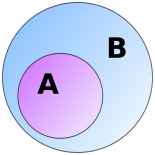
This item is a subclass (subset) of that item; ALL instances of this item are instances of that item; different from P31 (instance of), e.g.: volcano is a subclass of mountain; Everest is an instance of mountain.

: Instances of musical instruments (Q34379) are typically individual specimens and shouldn't be subclasses. If you're working with a proper subclass, try setting P31 = "type of musical instrument" (Q110295396)
: Often causes works of art to be conflated with the practice or study of art. Classes of artworks should be subclasses (directly or indirectly) of "work of art" (Q838948). Most exceptions should be the subject of separate none-of constraints.
: This statement leads to false inferences that conflate artworks with the practice or study of art. Exceptions should be the subject of separate none-of constraints.
: humans are generally not modelled via subclasses, often roles that humans can have are mistakenly defined as subclasses of a human; if unavoidable, instantiate occupation, role, or class of human instead.
: most items identified this way are actually instances (P31) of occupation. Making an occupation like "baker" a subclass of occupation implies (nonsensically) that all bakers are occupations.
: most items identified this way are actually instances (P31) of position. Making a position like "bishop" a subclass of position implies (nonsensically) that all bishops are positions.
: Industrial sector (Q8148) is not a class, but a particular sector of the economy. Individual industries should be instance of (P31) industry (Q268592) instead, and may be part of (P361) the industrial sector (Q8148) if they involve manufacturing.
: While exceptions may exist, most items can be more precisely specified as either a subclass of "group of humans" or an instance of "class of humans".